Lists Quick Start Guide
What are CSD lists?
CSD lists are intrusive linked lists based on the BSD queue(3) library. That library first appeared in 4.4 BSD, and is available today on most UNIX systems via the header file <sys/queue.h> (it is also included in glibc and can be found on most Linux systems). Linked lists are used to implement queues in various UNIX kernels, thus the name “queue.”
The original queue library has been copied into or reimplemented in many well-known C code bases, including the Linux kernel. Like most data structure libraries written in C, it relies on macros to achieve static polymorphism. CSD lists are C++20 re-implementations that combine the data structure design from BSD queues with the design of STL containers. For example, it achieves static polymorphism using templates instead of macros.
To learn why intrusive linked lists are great data structures, read Why Intrusive Lists?
CSD provides the four data structures from queue(3):
- slist
Singly-linked lists
- stailq
Singly-linked tail queues; a “tail queue” is a linked list that keeps track of the last element, which allows fast insertion at the end of the list and fast list concatenation; the combination of \(O(1)\) insertion at the end of the list and \(O(1)\) removal from the head of the list makes it easy to implement a classic FIFO queue data structure, thus the name “tail queue”
- tailq
Doubly-linked tail queues, i.e., doubly-linked lists that also have the tail queue features
- list
Warning
list is deprecated and should be avoided.
In the original
queue(3)library, there is a difference between aLISTand aTAILQ, but in CSD there is not. To meet the design goal of matching the STL, the C++ implementation of lists and tailqs must be exactly the same (see here for a detailed explanation). If<csg/core/list.h>is included, it makes lists available as tailq type aliases, but adds deprecation attributes.
A simple example
#include <iostream>
#include <csg/core/slist.h>

using namespace csg;

struct ListItem {
  int i;                        // List item's data
  slist_entry<ListItem> link;   // Intrusive link that makes us part of
                                // a `ListItem` singly-linked list
};

// The head of the list is a class template. The second template
// parameter is a functor that controls how the list locates the
// intrusive links inside the list items (in this case, via using
// a pointer-to-data-member access). Because this template is somewhat
// verbose, a number of helper macros and type aliases are available;
// one of these is shown immediately below and the rest of them are
// explained later in the documentation.
using list_t = slist_head<
  ListItem,                               // Type of items in list
  invocable_constant<&ListItem::link>,    // Functor to access list links
  std::size_t>;                           // Type for `size()`

// `slist_head_cinvoke_t` is an alias template that expands to the same
// definition above, so you would normally write this instead. It is
// syntactic sugar for the case where your intrusive link can be
// accessed via a constexpr invocable (thus "cinvoke"), such as a data
// member access or a "getter" member function. This helper alias wraps
// your invocable NTTP inside a functor, and you also don't need to
// write "ListItem" twice.
using list_t = slist_head_cinvoke_t<&ListItem::link, std::size_t>;

// Create an empty list and two items, then add the items to the list.
list_t L;
ListItem item1{.i = 1}, item2{.i = 2};

L.push_front(&item2); // Note: insertion by pointer. This is explained
L.push_front(&item1); // in the next section of this guide.

// Print the items.
for (const ListItem &item : L)
  std::cout << "This is item #" << item.i << std::endl;
This will print
This is item #1
This is item #2
Where do I find the API documentation?
There is deliberately very little doxygen documentation for CSD list member functions. They are meant to follow the standard C++ list APIs as much as possible, so you should use your favorite C++ reference (e.g., cppreference) for <list> when referencing tailq and <forward_list> when referencing slist or stailq.
However, because CSD lists are intrusive and because they follow the BSD data structure design patterns, there are some differences in the public API compared to standard C++ containers. The fundamental difference is that CSD lists – like all intrusive data structures – do not own their elements. A “list” consists of a small “head” object which points to the first (and possibly last) item in the list. The items themselves have a lifetime distinct from the list head’s lifetime and are allocated elsewhere, usually in a memory pool. An illustration of a CSD slist is shown below:
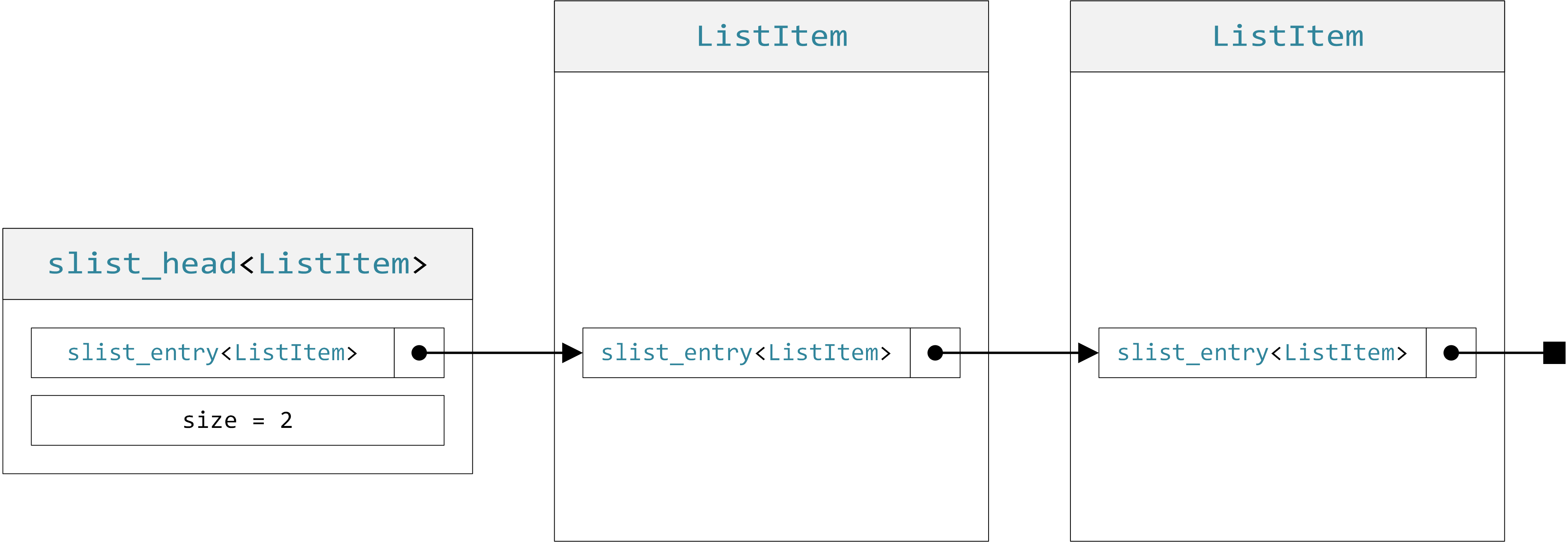
A CSD list object is little more than a pointer to the initial item; the items are not owned by the list, they are only linked into it (click to enlarge).
Compare this with node-based lists, like std::forward_list, which own their elements and store them in “node” containers that are allocated by the list itself. One possible implementation of this design is illustrated below:
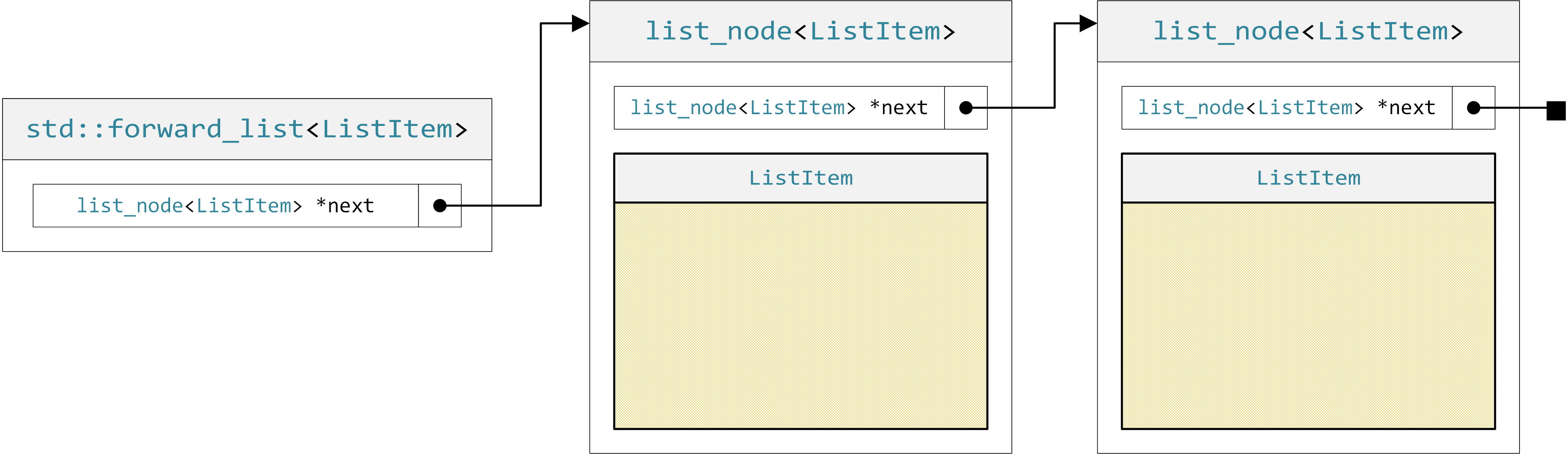
A typical node-based list (i.e., a non-intrusive list) has ownership over the elements, which are typically wrapped inside node objects. The lifetime of node objects is explicitly managed by the list itself (click to enlarge).
This fundamental difference gives rise to a variety of smaller API differences, be sure to read the section Differences between CSD lists and other STL containers for all the details. In short, the differences are:
CSD lists cannot be copied.
List items are neither copied nor moved into the list – they are just linked into it (their intrusive link member variable is modified to splice the item into the list).
As a consequence of the above, list items are always inserted by pointer, i.e., for a list of type
T, the insert family of functions require aT*value. To avoid breaking with the standard containers too much, all non-insertion member functions continue to useT&, e.g.,front()andback()continue to return a reference to the item, not a pointer to it.A list item cannot be added to multiple lists that use the same entry link.
The list destructor doesn’t actually destroy the items (because it does not own them).
As a result of this non-ownership, CSD lists are both borrowed ranges and non-copyable views.
CSD lists also provide some useful APIs which are not in the standard containers – see Methods in CSD lists that do not exist in the STL.
Choosing the template parameters
As can be seen in the example above slist_head has three template parameters:
- T
The type of the items in the list.
- EntryEx
The type of function object that extracts the intrusive link, given an instance of
T. In the example above, the intrusive link is the data membercsg::slist_entry<ListItem> link. The link object is called an “entry” from the name of the correspondingqueue(3)macros, e.g.,SLIST_ENTRY. See Choosing the EntryEx parameter for more information.- SizeMember
The C++ standard container
<list>offers \(O(1)\) access to its size by storing the list size inline and maintaining it during each modifying operation. The C++ standard container<forward_list>, and the BSDqueue(3)library do not track list size – getting the size is an \(O(n)\) operation that fully traverses the list to count each item. CSD lists allow the user to choose which behavior they want. See Choosing the SizeMember parameter for more information.
Choosing the EntryEx parameter
All intrusive data structures in CSD are parameterized by a template parameter called an extractor – in this case an Entry Extractor – that knows how to extract the intrusive book-keeping object from the user’s type.
Extractors are covered in detail in Extractors: the Core Intrusive Concept. That document explains the rationale for extractors and gives advice on how to define them. If you are new CSD intrusive data structures, you should read that section first. Below we cover the most common “syntactic sugar” way to declare the two main types of extractors: offsetof-based and invocable_constant-based.
Syntactic sugar for declaring extractors
Because the list head templates are so verbose – mainly because of the extractor parameter – CSD provides helper alias templates and macros. Ideally we would not use any macros, but code patterns involving offsetof typically cannot be expressed without resorting to macros.
For offsetof-based extractors:
struct ListItem {
  int i;
  slist_entry<ListItem> link;
};

// Instead of this...
using my_list_t = slist_head<
    ListItem,
    offset_extractor<slist_entry<ListItem>, offsetof(ListItem, link)>>;

// ...write this:
using my_list_t = CSG_TAILQ_HEAD_OFFSET_T(ListItem, link);
For most constexpr-invocable extractors – usually pointer-to-member based – we can use a helper type alias:
struct ListItem {
  int i;
  slist_entry<ListItem> link;
};

// Instead of this...
using my_list_t = slist_head<
    ListItem,
    invocable_constant<&ListItem::link>>;

// ...write this:
using my_list_t = slist_head_cinvoke_t<&ListItem::link>;
Ideally, this helper alias would work with all invocables, not just constexpr ones. Unfortunately as of C++20, there is no “invocation traits” class that would allow us to discover the type of the first argument to the invocable, no matter what form it has. As of C++17, constexpr invocables can take a limited number of forms (free functions, member function pointers, etc.) and a traits class is provided that partially specializes all known syntactic forms and exposes the argument type. This won’t cover the additional constexpr invocables that were added in C++20 unfortunately (constexpr non-type arguments, e.g., a constexpr lambda extractor). For cases that are not covered, the user must resort to the verbose declaration.
Choosing the SizeMember parameter
The SizeMember parameter can either be an integral type (in which case, the internal size member will be a field of that type) or it can be the special type csg::no_size, which removes the size member and gives the \(O(n)\) behavior.
The csg::no_size option is more in-keeping with historical BSD design because typically, the size of most lists will not be greater than the maximum value of std::uint32_t. However, if SizeMember is actually set to std::uint32_t, the user will probably waste 4 bytes of tail padding unless they are careful to pack small members directly after the list head object. It will not be immediately clear from the code that valuable cache line space might be being wasted, so csg::no_size is generally preferred. For this reason, no_size is also the default template argument for SizeMember, hence why it is unspecified in most of the later examples.
Because the list’s items are typically allocated from a pool allocator, there is usually a factory function which allocates items and places them on lists – this is a natural place for the user’s own size maintenance code.
Understanding the head vs fwd_head + proxy templates
Suppose you want to create a CSD singly-linked list (slist) head. You have two options:
Use the
slist_headclass templateUse a combination of the
slist_fwd_headandslist_proxyclass templates
Consider this code from the example above:
struct ListItem {
  int i;
  slist_entry<ListItem> link;
};

using list_t = slist_head<
  ListItem,
  invocable_constant<&ListItem::link>,
  std::size_t>;
Note that the expression &ListItem::link requires ListItem to be a complete type. 1 This means that the list_t type alias cannot be declared before the ListItem type is defined, nor can any instance of the list. That is, the following does not work:
struct ListItem;

using list_t = slist_head<
  ListItem,
  invocable_constant<&ListItem::link>, // Error: incomplete type in nested-name specifier
  std::size_t>;

// Definition is below, but it's too late!
struct ListItem {
  int i;
  slist_entry<ListItem> link;
};
This restriction did not exist in the original queue(3) C library. In exchange, the queue(3) equivalent of the “entry extractor” (the name of the field for the “entry” object) has to be specified in almost every macro that accesses the list, e.g., the link field name would need to be specified when performing an insert: SLIST_INSERT_AFTER(item_before, item, link). CSD avoids this by baking the entry extractor details into the type definition, via a template argument. This is much friendlier API-wise, but requires the type to be complete.
If a list head must be declared before the item type is complete, it can be declared using the corresponding fwd_head (“forward head”) template, e.g., slist_fwd_head. This template only requires the T and SizeMember template parameters. Note that although T is a required parameter, it can be an incomplete.
To actually use the list, the proxy type slist_proxy is constructed, taking a reference to the slist_fwd_head, and imbuing it with the EntryEx template parameter.
The following example illustrates this:
struct ListItem; // Note: not complete yet

struct S {
  stailq_fwd_head<ListItem, std::size_t> allItemsFwd; // Collection of ListItems
};

struct ListItem {
  int i;
  slist_entry<ListItem> link;
};

// Now that ListItem is a complete type, define `list_proxy_t` as an
// `slist_proxy` instead of `slist_head`.
using list_proxy_t = slist_proxy<
    stailq_fwd_head<ListItem, std::size_t>, // Type of the fwd head
    invocable_constant<&ListItem::link>>;   // Late-specified EntryEx

void printItems(S &s) {
  // Construct a list_t proxy container, passing in the head object.
  list_proxy_t allItems{s.allItemsFwd};

  for (const ListItem &item : allItems)
    std::cout << "This is item #" << item.i << std::endl;
}
As usual, a helper type alias makes the verbose template type easier to declare:
using list_proxy_t = slist_proxy_cinvoke_t<&ListItem::link, std::size_t>;
The “proxy” types are extremely cheap to construct (for stateless entry extractors, they only capture a reference to the “forward head”) and should be completely elided at higher optimization levels. They are also implicitly constructible from the corresponding fwd_head type, so the user can usually avoid explicitly constructing them, e.g.:
void printItems(const list_proxy_t &allItems);

void foo(S &s) {
  printItems(s.allItemsFwd); // OK: calls the list_proxy_t converting constructor
}
The fwd_head and proxy classes separate the list’s data storage (in the fwd_head) from the list’s behavior (in the proxy), which allows list storage to be declared before the item type is completed 3. A fwd_head and proxy pair are somewhat like a std::mutex and a std::unique_lock: the former generally stores the state of the object, and the latter is “constructed around it,” as a means of operating on it.
The (somewhat awkward) need to construct a proxy object each time is roughly analogous to the (somewhat awkward) need to specify the linkage member each time in the old queue(3) macros. Thus, when you don’t need the flexibility of the fwd_head + proxy pattern, prefer the “all-in-one” alternative, e.g., slist_head.
As with the “head” versions, a helper macro is available to declare proxy types that use offsetof-based extractors:
struct ListItem {
  int i;
  slist_entry<ListItem> link;
};

using mylist_proxy_t = CSG_TAILQ_PROXY_OFFSET_T(ListItem, link);
Are fwd_head instances movable?
For most CSD intrusive containers, the “forward head” types are moveable, to permit code like this: 2
struct ListItem;

struct T {
  T() = default;
  T(T &&) = default; // OK, `fwdItems` is movable

  slist_fwd_head<ListItem> fwdItems;
};
Unfortunately this cannot work for certain data structures, namely tailq_fwd_head:
struct ListItem;

struct T {
  T() = default;
  T(T &&) = default; // Error: tailq_fwd_head's move constructor is deleted

  tailq_fwd_head<ListItem> fwdItems;
};
This is a consequence of a tailq implementation detail, namely that tailq’s are circular lists with the end() sentinel connecting the head to the tail.
Because the head and tail list items must point to the address of the tailq_fwd_head instance (which plays the same role as tailq_head in this diagram), the move logic needs to access the EntryEx extractor so it can edit the head and tail entries, namely to rewrite their linkage into the sentinel node. In short, a tailq_fwd_head by itself lacks the information needed to move the list; we must construct proxies to help move it.
To work around this limitation, the user must define a custom move constructor:
struct ListItem;

struct T {
  T() = default;
  T(T &&) noexcept;

  tailq_fwd_head<ListItem> fwdItems;
};

struct ListItem {
  int i;
  tailq_entry link;
};

using list_proxy_t = tailq_proxy<tailq_fwd_head<ListItem>,
    tailq_entry_offset<offsetof(ListItem, link)>>;

T::T(T &&other) noexcept {
  list_proxy_t ourItems{this->fwdItems, list_proxy_t{other.fwdItems}};
}

void f() {
  S s[] = { {.i=1}, {.i=2} };
  T t1;

  // Construct a tailq container proxy so we can insert items into t1's list.
  list_proxy_t items1{t1.fwdItems, {&s[0]. &s[1]}};

  T t2{std::move(t1)}; // Invoke our custom move logic

  assert(std::size(items1) == 0 && std::size(list_t{t2.fwdItems}) == 2); // OK
}
Understand the CSD list concepts
Most of the implementation of an slist is contained in the class template slist_base. Both slist_head and slist_proxy inherit the core slist API from this base class using the CRTP. The only difference between slist_head and slist_proxy is that the former is more “elegant,” at the expense of requiring complete types.
A function taking any kind of slist can be defined like this:
template <csg::slist ListType>
void f(ListType &anySList);
The single-argument concepts tailq, stailq, and slist evaluate to true if the given type argument is a CSD list of the appropriate kind. The concept singly_linked_list can be used to check for either stailq or slist, which have similar APIs because they are both singly-linked lists. All CSD lists satisfy the linked_list concept.
Footnotes
- 1
As explained in Extractors: the Core Intrusive Concept,
&ListItem::linkmay also appear inside the body ofListItemwhile it is still being defined, as long as the field declaration has already occurred.- 2
The user must be careful when using movable
fwd_headinstances. Any proxy` instances still attached to the forward head will now affect the moved-from head. The effects of doing this are undefined.- 3
In Choosing the EntryEx parameter we note that the user is free to use a stateful entry extractor. These can be difficult to work with when using the
fwd_head + proxypattern, because the extractor state must be passed to eachproxyinstance (proxyinstances are ephemeral wrapper types with short life-spans). For entry extractors which contain move-only types (e.g., aunique_ptr) it should still be possible, but may not be worth the effort.